01
The problem
A typical small restaurant in India runs on five disconnected tools: a billing machine at the counter, a separate tablet for Swiggy and another for Zomato, handwritten kitchen tickets, and a WhatsApp group for regulars. Each one works on its own, and none of them talk to each other.
In the lunch and dinner rush that breaks down in predictable ways. A delivery order is missed because the tablet was on silent. The kitchen cooks a dish twice because a paper ticket was copied. A guest asks for the bill on WhatsApp and the cashier types it out by hand. At closing, nobody knows the day's real takings until the cash, card, UPI and platform payouts are added up on paper.
The owners we spoke to did not want more software. They wanted fewer screens: one system that runs on the phones, tablets and PC they already own, that a new waiter can learn in an afternoon, and that does not need an IT person to install or update.
02
Who uses it
We designed RestroTech around the five people who touch an order, each with their own screen and their own permissions.
- Owner
- Sees takings, orders and table status live from anywhere, closes the day's cash, reads reports and sets up menu, staff, taxes and integrations.
- Cashier
- Takes counter and takeaway orders, enters Swiggy and Zomato orders, splits and settles bills, and sends the bill to the guest on WhatsApp.
- Waiter
- Opens a table on a phone, adds items course by course, and sees when dishes are ready to serve.
- Kitchen
- Works from a kitchen display grouped by station, with a sound for each new ticket and printed tickets if the kitchen prefers paper.
- Guest
- Orders from a QR code at the table or the self-order kiosk, sees their order number on the token board, and receives the bill on WhatsApp.
03
What we built
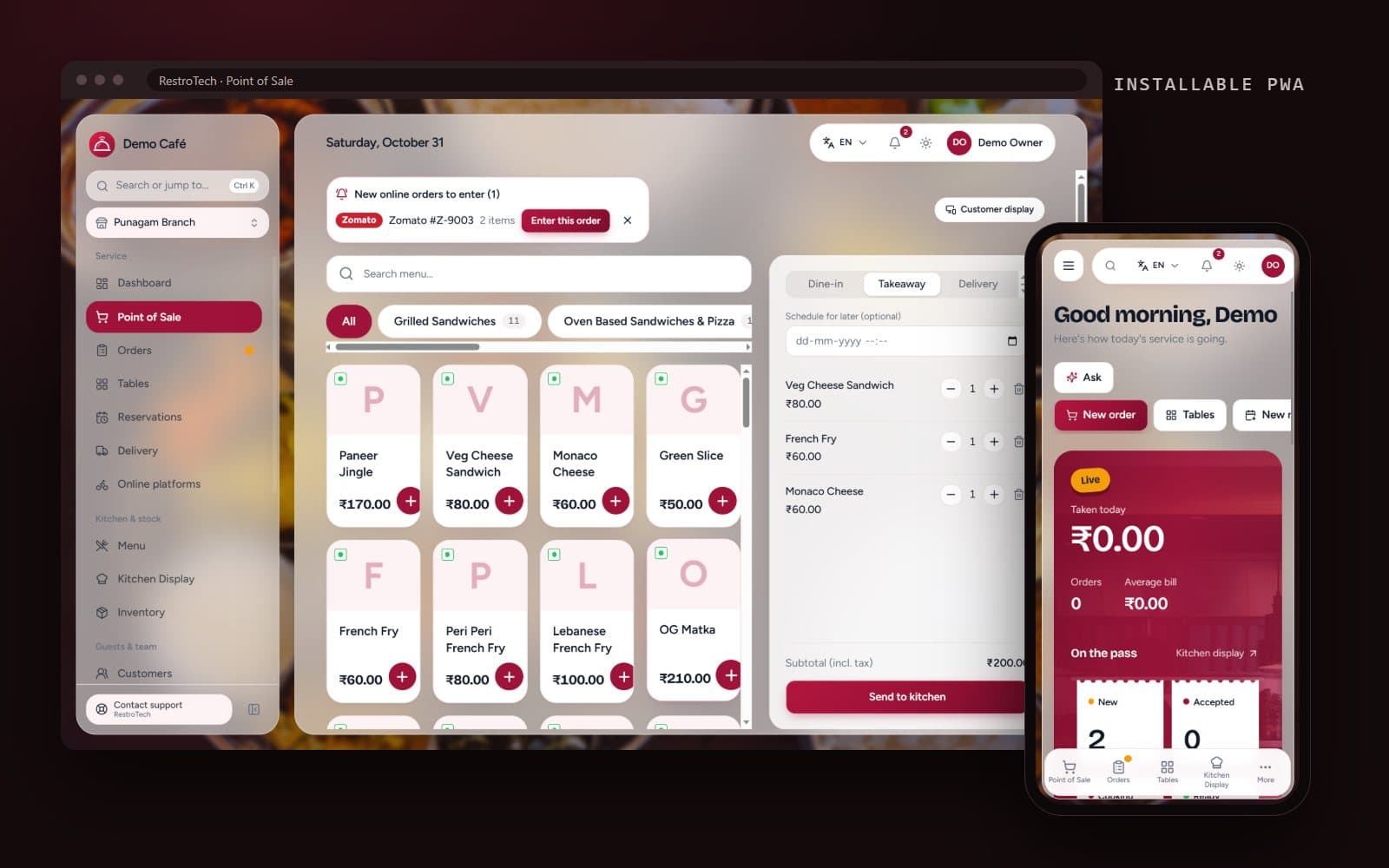
One platform brings every order into a single kitchen queue: counter and table orders on the POS, guests ordering from a QR code at the table, a self-order kiosk, the restaurant's own online ordering page, and Swiggy and Zomato orders, received through UrbanPiper or entered in seconds from the partner app.
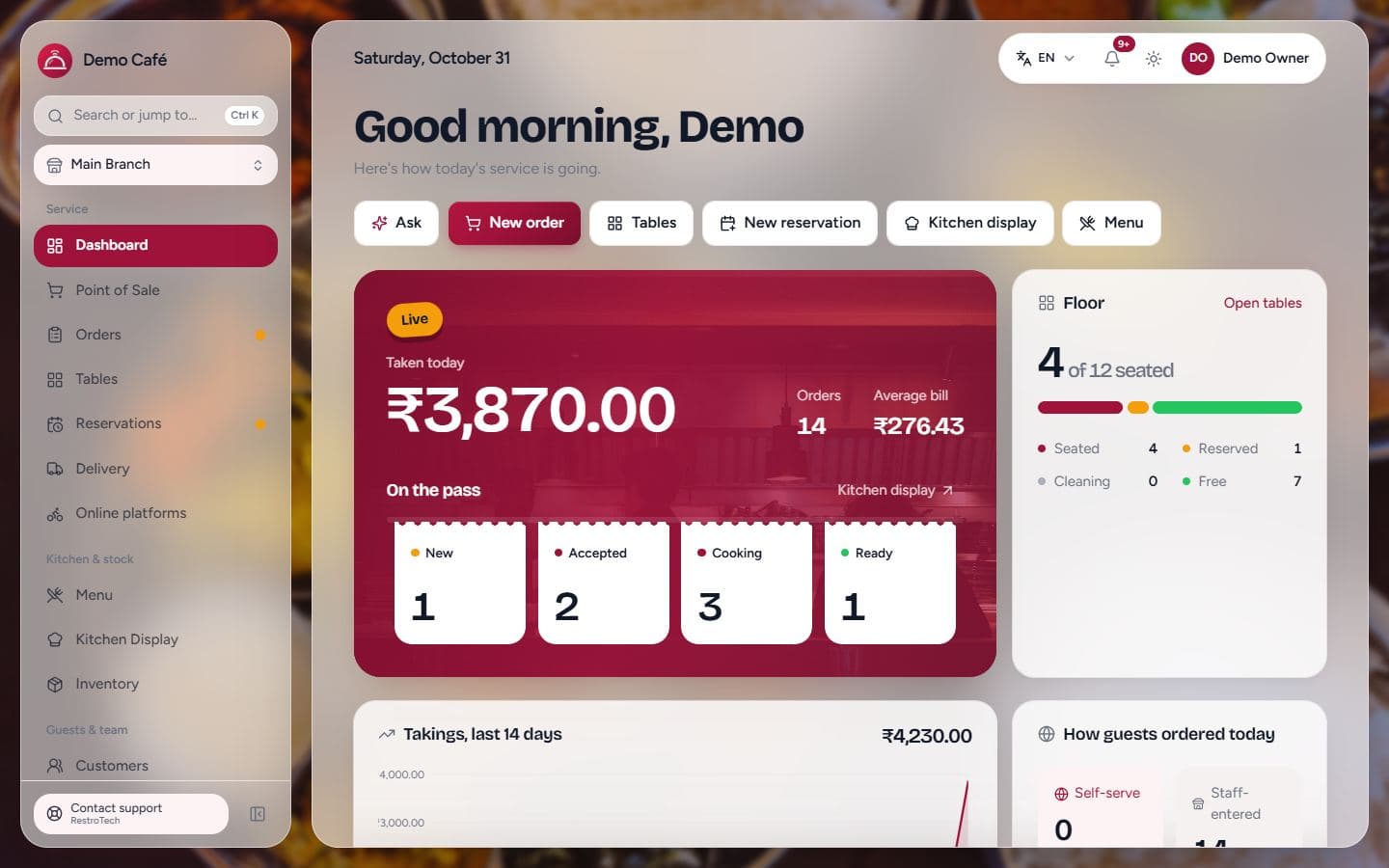
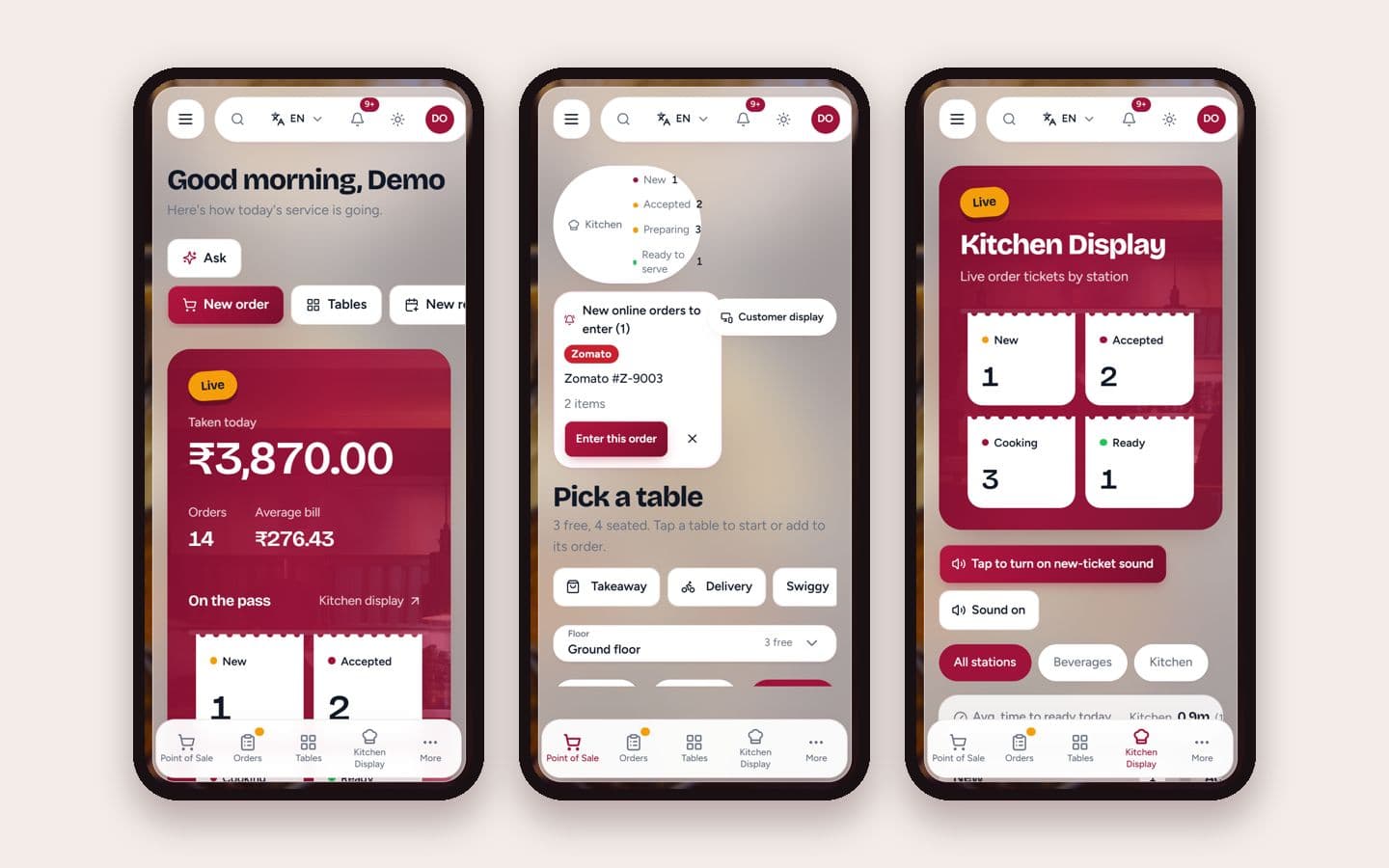
The owner's dashboard opens on what matters during service: money taken today, orders and average bill, what is on the pass, and how full the floor is. Everything updates live, without refreshing the page.
04
Kitchen and floor
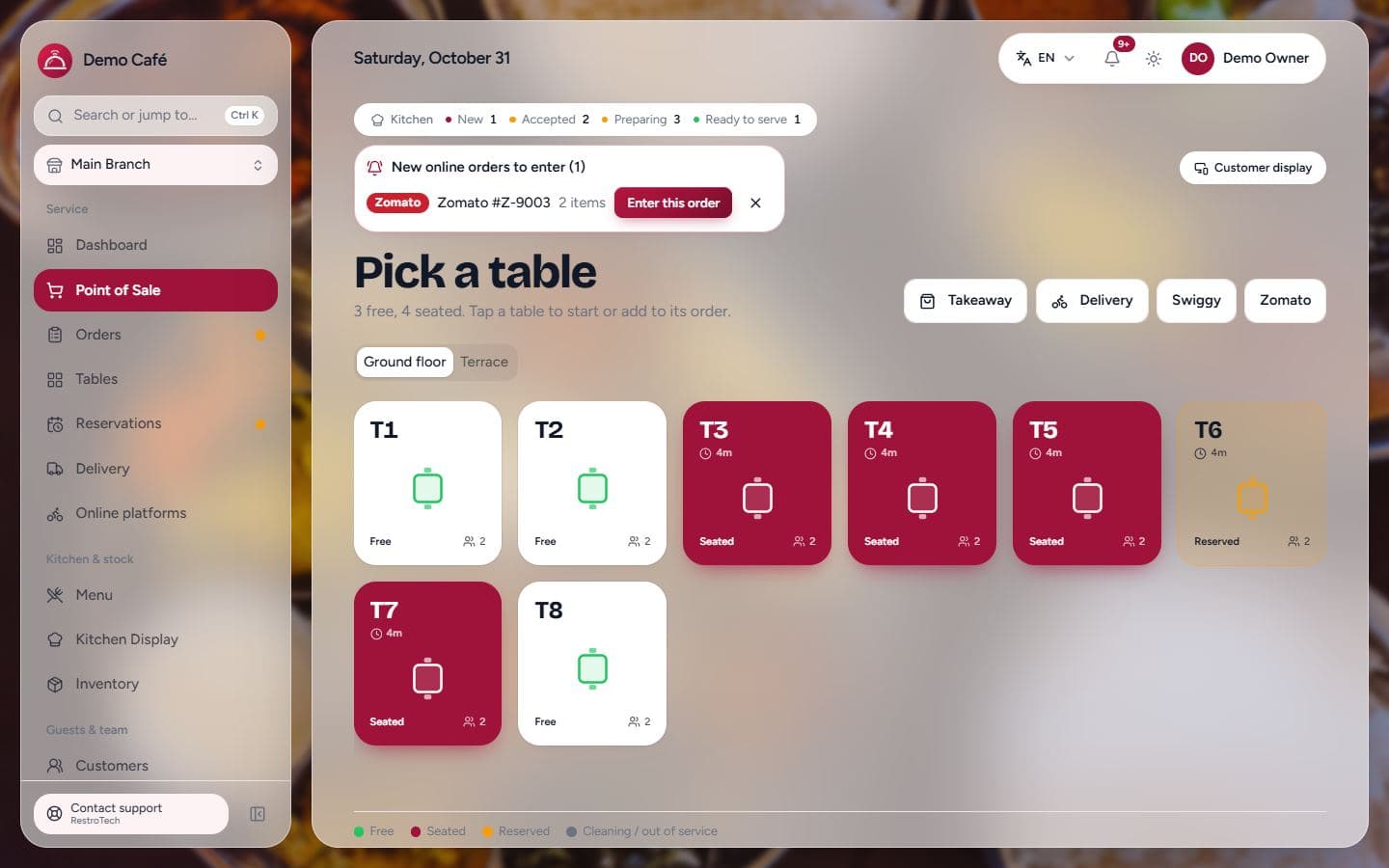
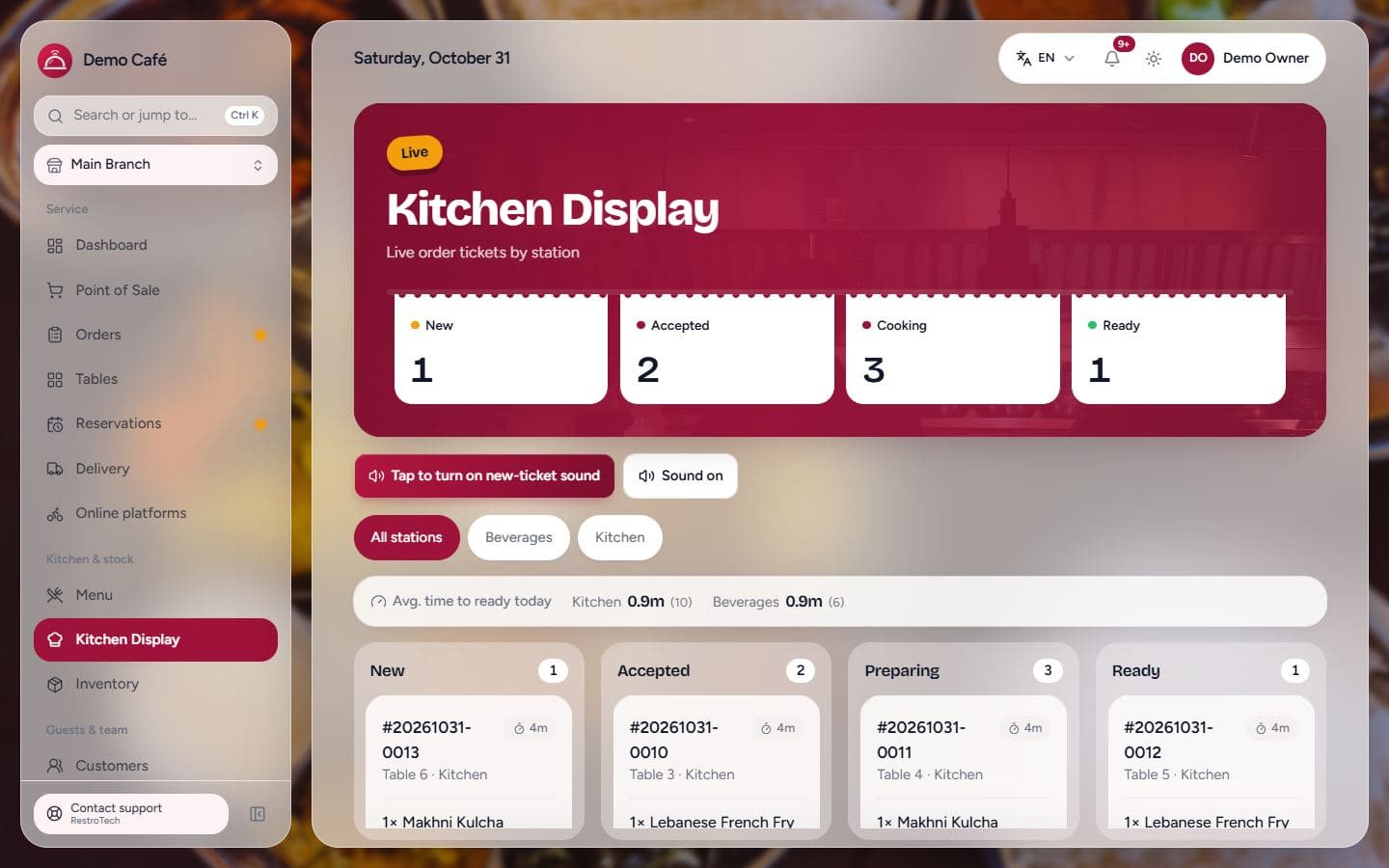
Each order is split into tickets by kitchen station, so the beverage counter only sees drinks and the grill only sees grill items. Tickets move from New to Accepted, Cooking and Ready with one tap, and every screen in the restaurant, including the waiter's phone and the POS, sees the change instantly over Socket.IO.
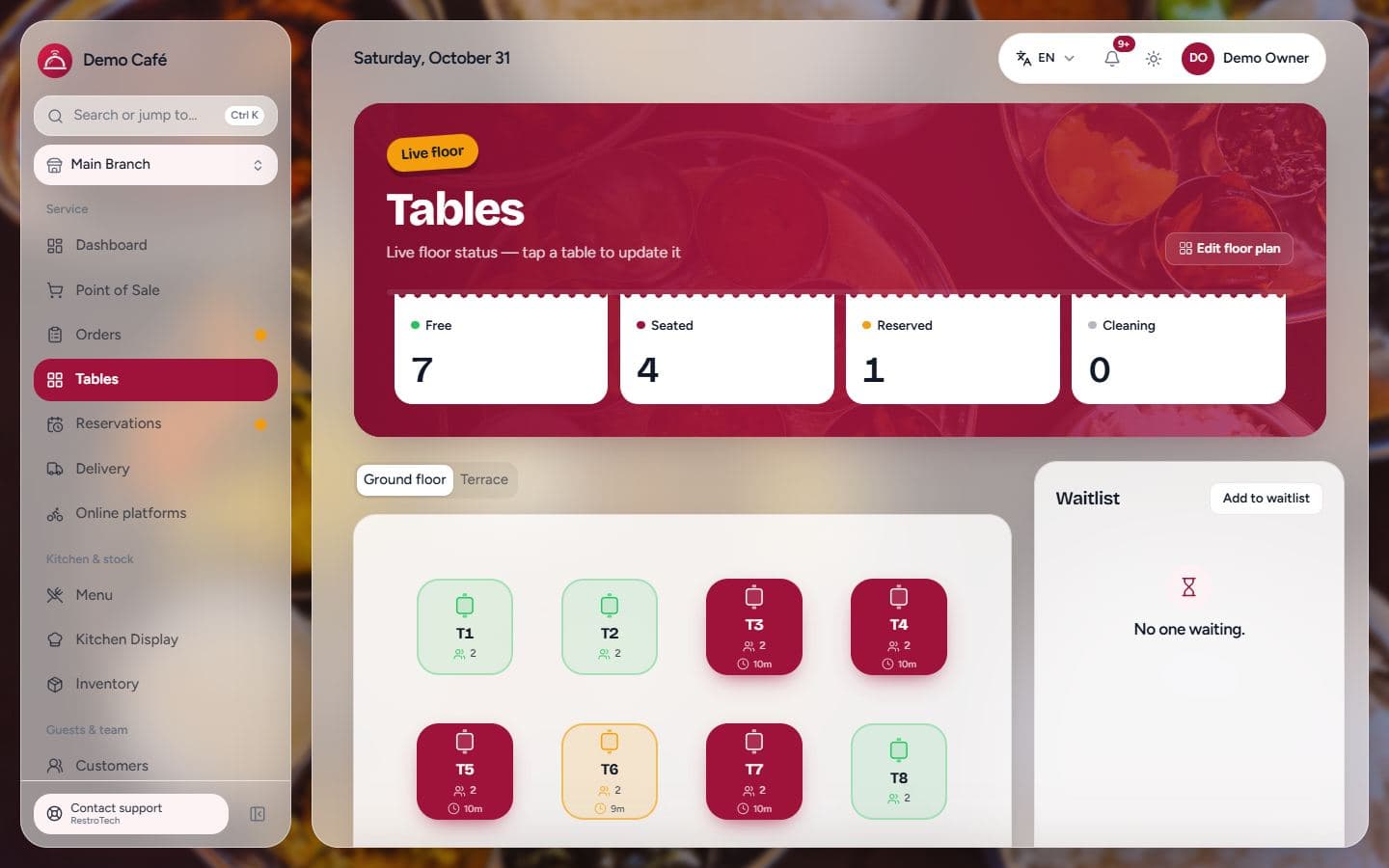
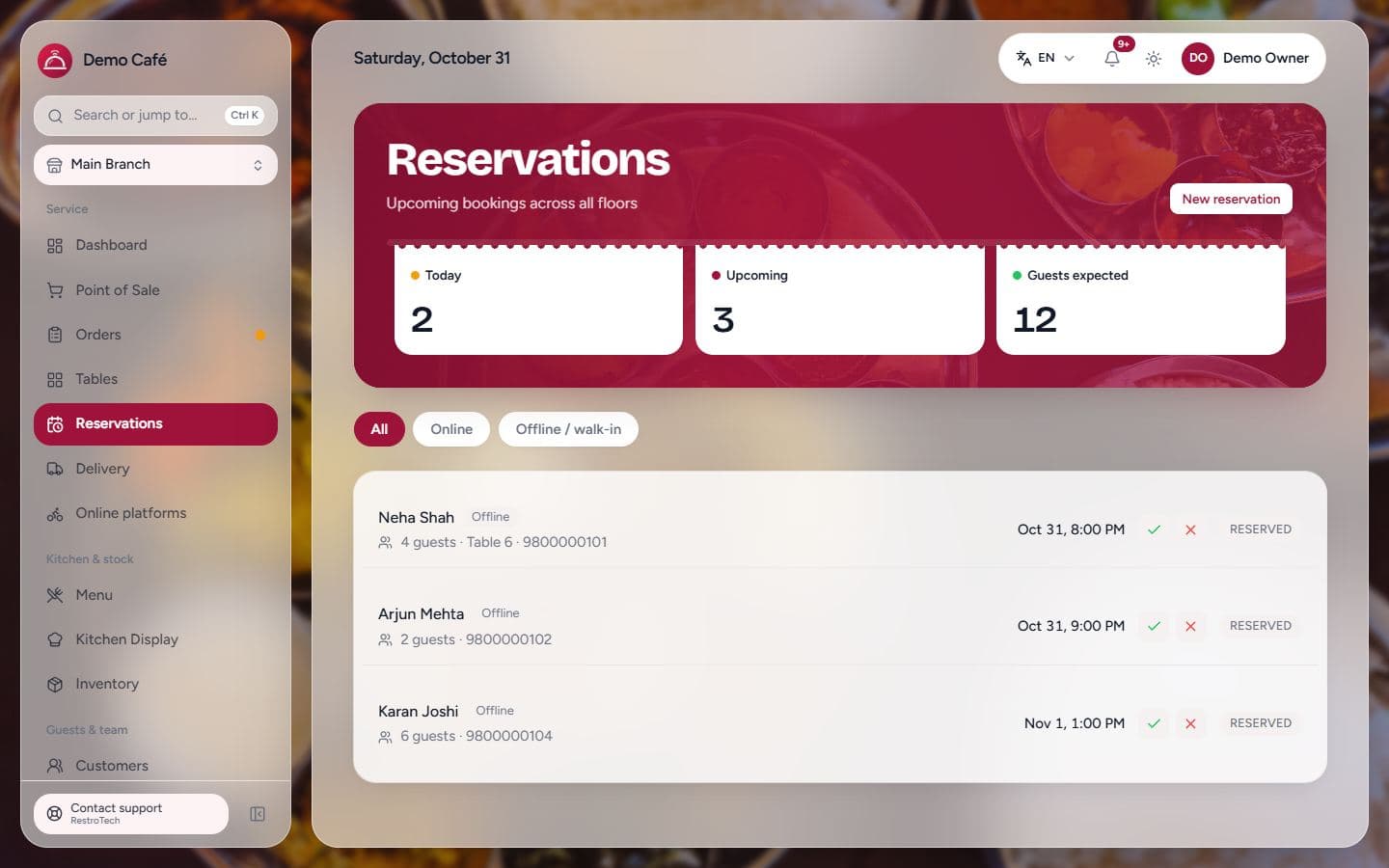
The floor plan shows every table's state by colour (free, seated, reserved, cleaning) with how long guests have been seated, and reservations and the waitlist sit next to it so the host can seat walk-ins without double-booking a table.
05
The hard parts, and how we solved them
Most of the engineering time went into a handful of problems that only show up in a real restaurant at peak hour.
- Swiggy and Zomato without an API contract
- Direct platform APIs need a commercial agreement most small restaurants do not have. We support UrbanPiper for those who use it, and for everyone else built a fast manual entry: pick the platform, type the order ID from the partner app, tap the items. The order goes to the kitchen labelled with the platform and its order ID, and counts as paid by the platform, so the cash close still adds up.
- WhatsApp bills without waiting weeks for approval
- The official WhatsApp Business API needs Meta verification and approved templates. We let the restaurant link its own WhatsApp number by scanning a QR code, then send each bill as a PDF from that number. Promotional messages are sent at a steady pace, not in one burst, so the number is not flagged as spam. Restaurants that do have a provider can connect Gupshup, Interakt, MSG91 or Meta Cloud instead.
- Never charging a guest twice
- On a busy counter with patchy Wi-Fi, a cashier will tap Pay twice. Every checkout carries a one-time request key, and a repeat of the same key returns the first result instead of taking payment again. The self-order kiosk does the same for orders, so a dropped connection can never turn into two orders.
- Printing from a browser
- Restaurants want a thermal printer, and browsers are bad at printing receipts. RestroTech prints through the browser's print dialog, or directly to USB and network ESC/POS printers. Kitchen tickets print once per ticket, and a reprint is stamped REPRINT so the kitchen never cooks a duplicate.
- Indian tax on every bill
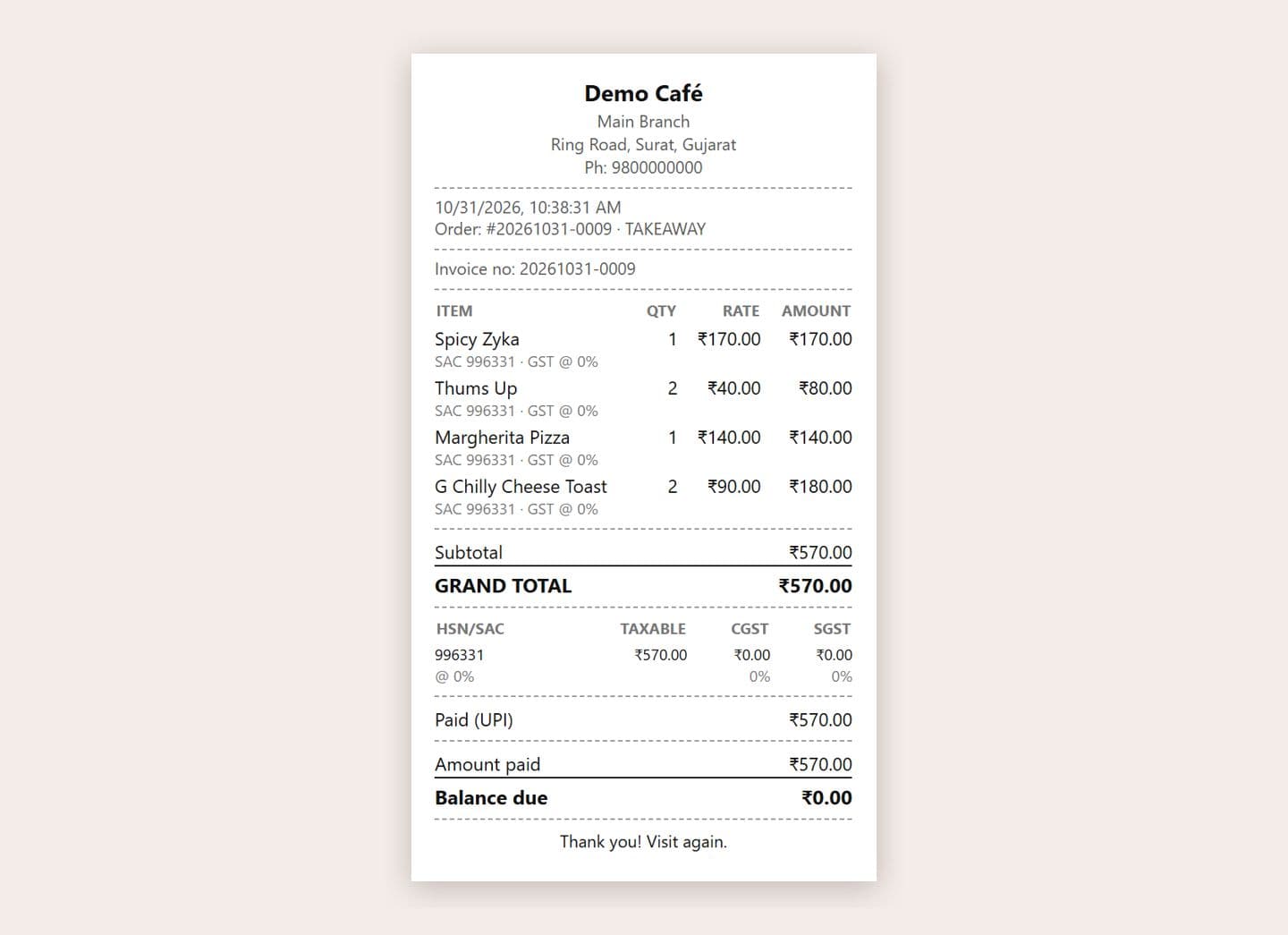
- Menu prices in India are usually tax-inclusive, while bills must show CGST and SGST with HSN/SAC codes. Prices, discounts, loyalty points and tips are calculated once on the server, so the printed bill, the WhatsApp PDF and the GST report always show the same figures.
- Many restaurants on one platform
- RestroTech is multi-tenant: every restaurant and branch has its own menu, staff, roles and data, kept strictly apart, and a platform panel lets us onboard a new restaurant in minutes.
06
Bills, WhatsApp and reports
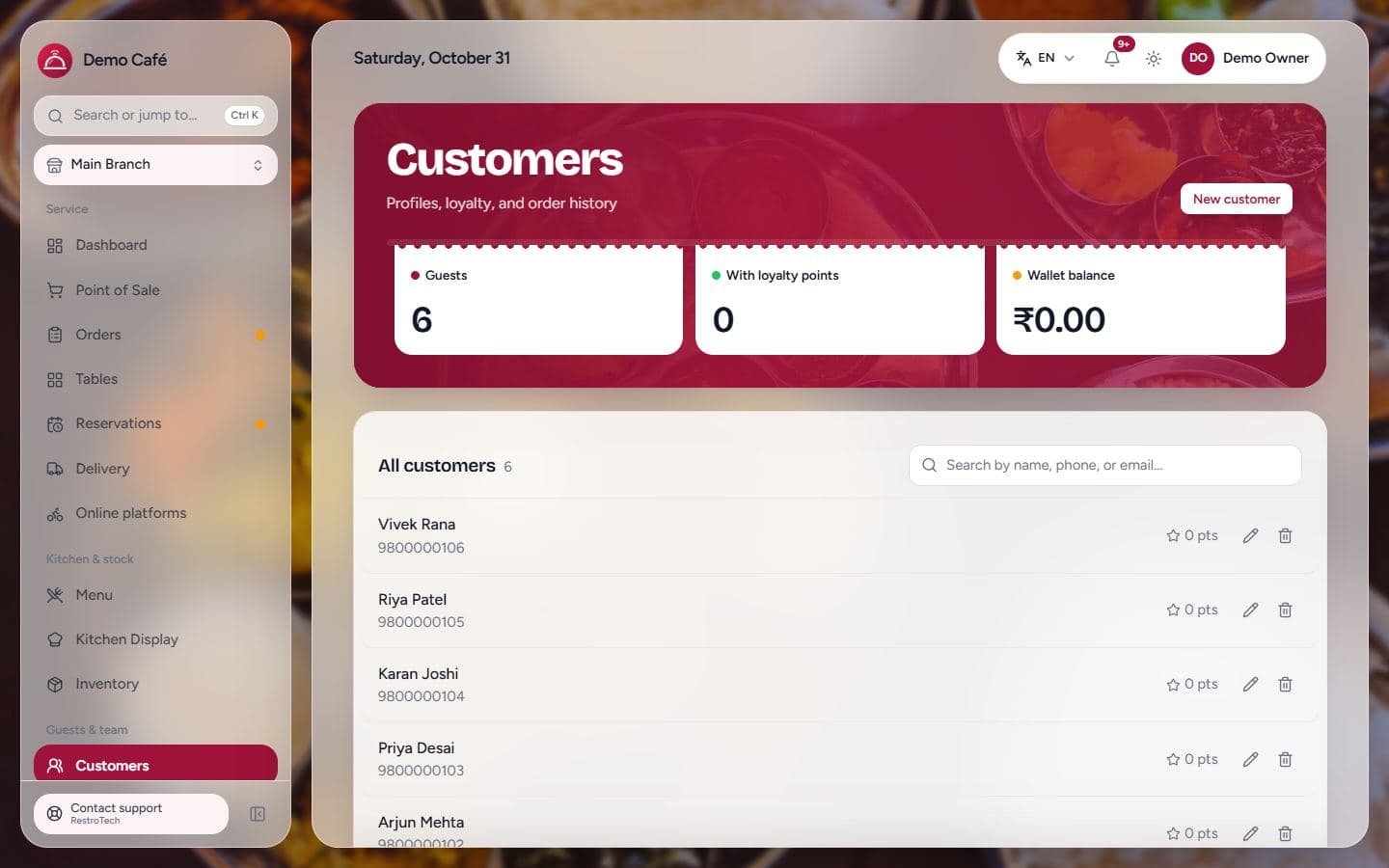
At checkout the cashier types the guest's WhatsApp number and the bill goes out as a PDF from the restaurant's own number. The same number is remembered against the guest, so repeat visits, loyalty points and order history build up without a separate sign-up.
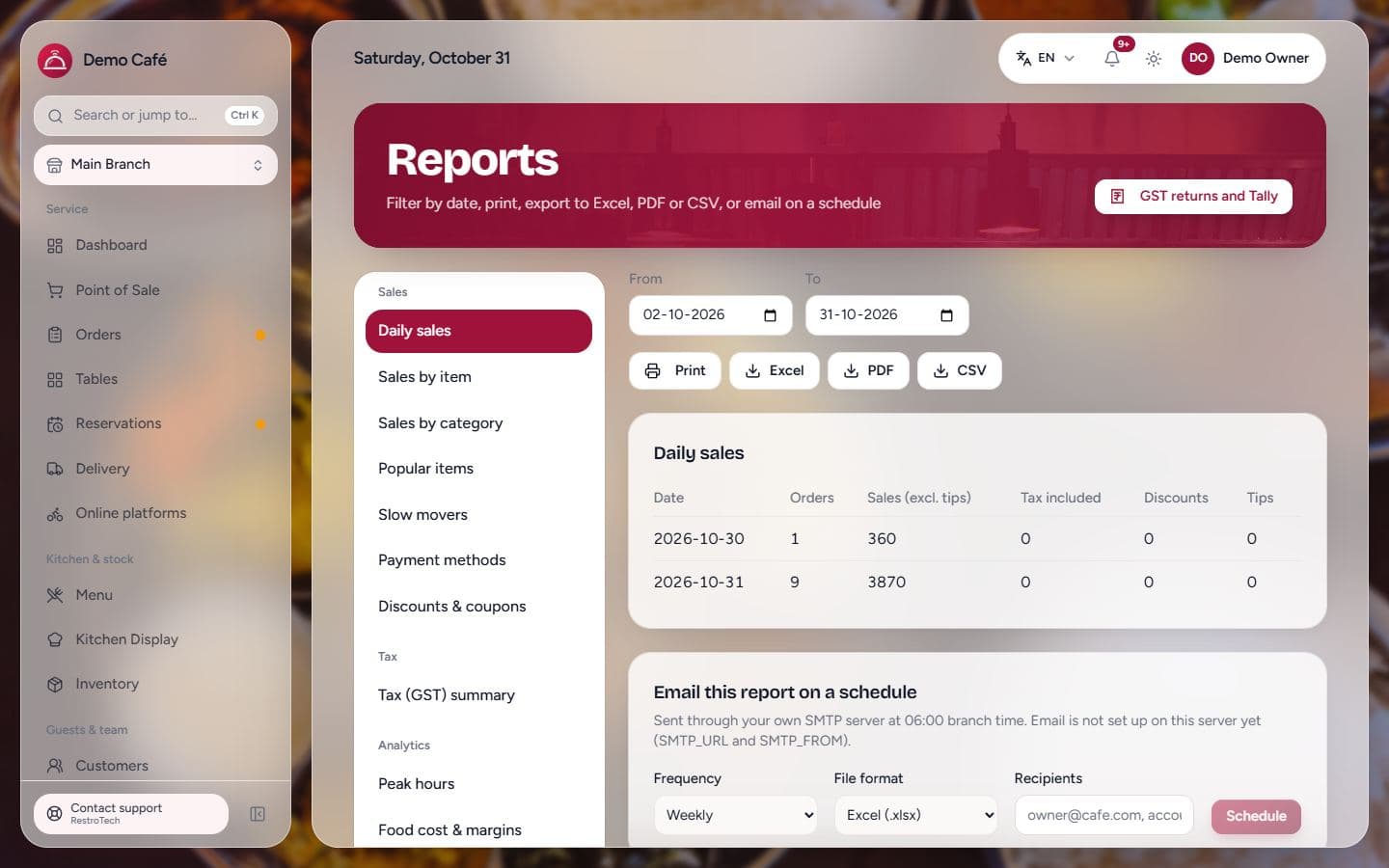
Reports cover daily sales, sales by item and category, popular and slow items, payment methods, discounts, peak hours, food cost and a GST summary. Any report can be printed, exported to Excel, PDF or CSV, or emailed to the owner on a schedule.
07
Why a Progressive Web App
We chose a PWA instead of separate store apps. It installs from the browser onto a phone, tablet or counter PC, opens full screen like any app, and updates for every restaurant the moment we ship a change, with no app-store review in between.
One codebase serves the owner's dashboard, the waiter's phone, the kitchen screen, the kiosk and the guest's QR menu. On a phone the same screens switch to a bottom navigation bar and larger touch targets, so a waiter can run a table one-handed.
The trade-off is honest: RestroTech needs an internet connection to take orders. For a restaurant that is a smaller risk than it sounds, because a mobile hotspot keeps service running if the broadband drops.
08
Results
RestroTech went live with its first restaurant, a sandwich restaurant in Surat, in October 2026. Orders from the counter, QR tables, the kiosk and delivery platforms now arrive in one kitchen queue, bills reach guests on WhatsApp, and the owner sees the day's takings and closes the day's cash from the dashboard.
Each role has a short captioned tutorial video, so new staff can learn the screens on their own. The interface works in English, Hindi, Gujarati, Marathi and Tamil, so each person can use it in the language they are most comfortable with.
09
What we'd do differently
We would design the kitchen and customer-facing screens for real counter conditions even earlier: glare, gloves, noise and one free hand. The fixes we made after watching real use, such as a faster takeaway flow and a clearer ready-order display for guests, mattered more than any new feature.
We would also bring the WhatsApp set-up into the first day of onboarding. Owners valued bills on WhatsApp more than almost anything else, and it is the feature that makes guests notice the change.